
About RUCO
Edible vegetable oils are used in frying of foods. During frying, the quality of oil deteriorates. The practice of reheating cooking oil or using the same cooking oil for frying is common. Cooking oil is often repeatedly used by topping it up with fresh oil. This Used Cooking Oil is also a potential feedstock for manufacturing biodiesel. Therefore, FSSAI has launched ‘Repurpose Used Cooking Oil’ (RUCO) – an ecosystem to enable the collection and conversion of used cooking oil to biodiesel. RUCO (Repurpose Used Cooking Oil) has been created. It is an ecosystem to enable the collection and conversion of UCO to biodiesel.

Significance of the initiative
Currently, used cooking oil is either not discarded or disposed of in such a manner that it chokes drains and sewerage systems. Apart from setting quality standards, the new regulation addresses the way this oil is discarded. As used cooking oil is considered the most reasonable feedstock for biodiesel production, the FSSAI is planning to redirect the used cooking oil from the food business operators. It has already started collecting used oil in small quantities either through a barter arrangement or at cost.
FSSAI believes India has the potential to recover 220 crore litres of used cooking oil for the production of biodiesel by 2022 through a co-ordinated action. While biodiesel produced from used cooking oil is currently very small, but a robust ecosystem for conversion and collection is rapidly growing in India and will soon reach a sizable scale.
Using the Same oil repeatedly for frying leads to changes in the physico-chemical, nutritional and sensory properties of the oil. It also leads to the formation of Total Polar Compounds (TPC), which makes the oil, unit for human consumption beyond certain limits.
Generally, big food businesses involved in the manufacturing of fried foods dispose of their used cooking oil (UCO) for industrial purposes (soap manufacture, etc.) but sometimes it finds way to small food vendors at cheap prices. At household level or by road-side vendors, the UCO is discarded in an environmentally hazardous manner blocking the sewerage and drainage systems.
Therefore, in order to safeguard public health, FSSAI has notified the limit of Total Polar Compounds (TPC) to be not more than 25% beyond which the oil is unsafe for human consumption. From 1st July, 2018 onwards, all Food Business Operators (FBOs) are required to monitor the quality of oil during frying by complying with the said regulations.

RUCO – Implementation
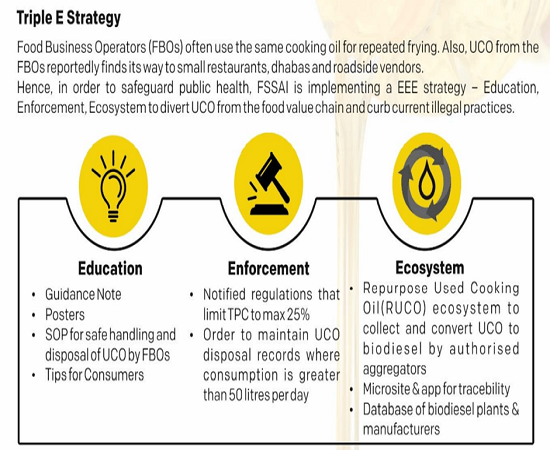
FSSAI is implementing an EEE Strategy –
- Education
- Enforcement
- Ecosystem
to divert Used Cooking Oil from the food value chain and curb current illegal practices. The EEE Strategy approach ensures good health and welfare for all 130-crore citizens, aiding energy security, climate change mitigation, and leading to environmentally sustainable development.
Handling & Disposal of Used Cooking Oil (UCO)
A guide note published by FSSAI, outlines the Standard Operating Procedure (SOP) for safe handling and disposal of UCO for the beneit of consumers as well as small and big Food Business Operators (FBOs).
Procedure for Basic Handling of Cooking Oil at Households
- At household level, oil once used for frying foods should be filtered and may be used for curry preparation in order to make it economical.
- Avoid using the same oil for frying.
- UCO should be disposed when blue-grey smoke appears or tough foam gets formed or oil becomes dark and murky or the consistency of oil changes. These are some of the indications of deteriorated quality of oil.
- Used Cooking Oil should be consumed in a day or two.
- It should not be stored for longer times as the rate of deterioration is higher in used oil.
- Do not reill the fresh oil container with UCO. Store it separately.
- In order to dispose small quantities of UCO, mix the oil with an absorbent material, such as sand or sawdust orused towel or paper towel or food scraps to avoid the chances of spillage and then throw it away in dustbins.
- Do not use same oil for more than three times. It is ideal to use only once
- Cooking oil should be filtered frequently to remove food particles.
- UCO should be disposed when blue-grey smoke appears or tough foam gets formed or oil becomes dark and murky or the consistency of oil changes. These are some of the indications that the quality of oil has deteriorated.
- Do not dispose of the discarded oil in drains/sewerage systems.
- UCO should be discarded in an environment friendly way preferably by providing it to theauthorized UCO aggregators/ collection agencies that are registered with authorized agencies such as States Biodiesel Boards, Biodiesel Association of India and other agencies nominated by state government to collect such oil for the manufacture of biodiesel or any other industrial purpos.
- Keep UCO away from lame, gas cylinders etc.
- FBOs should refrain from buying UCO for manufacturing their foods products.
- Cooking oils having developed Total Polar Compounds beyond the limit of 25% are hazardous waste. Discard such edible oil.
- Keep the discarded oil in a separate container once it is cooled. Keep headspace while filling. Always label the container to avoid cross contamination.
- Do not transfer hot oil to avoid chances of spilling and injury.
- Transfer the used cooking oil safely into the collecting drums provided by authorized collection agency.
- Keep used cooking oil away from lame, gas cylinders etc.
- UCO should be discarded in an environment friendly way preferably by providing it to the authorized UCO aggregators /collectiona gencies that are registered with authorized agencies such as States Biodiesel Boards, Biodiesel Association of India and other agencies nominated by state government.
- All Food Business Operators should train their staff responsible for handling and disposal of used cooking oil regarding procedures prescribed in this document.